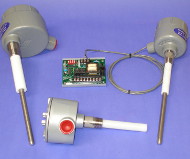
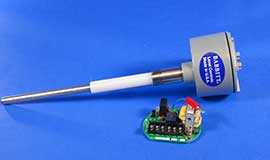
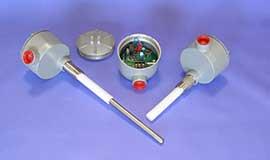
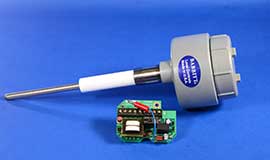
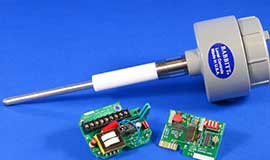
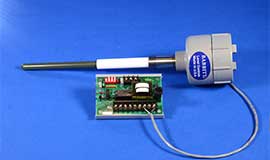
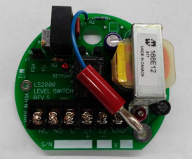
Point Level Switches are used to determine when a liquid or dry material has reached a predetermined level. Once the media reaches the level, a contact open or closes and sends an output to an alarm, pump, PLC or other control device. These types of instruments are ideal when continuous measurement or monitoring of intermediate level is not important. Point level switches are typically used to control low or high levels in tanks, hoppers, silos or other vessels in order to improve efficiency and to prevent spills or overfill conditions. These units can also be used as secondary instrumentation to provide redundancy in the event that the primary instrument fails. Point Level Switches are also commonly referred to as a Point Level Sensor, Water Leak Sensor, Water Sensor Alarm, Liquid Level Switch, Liquid Level Sensor, Leak Detection Sensor, High Level Switch, Pump Control Switch, Silo Level Indicator and Bin Level Monitor.
Standard and custom units are available. To determine which instrument is right for your application, visit our Point Level Switch Comparison Page or contact us for application assistance.
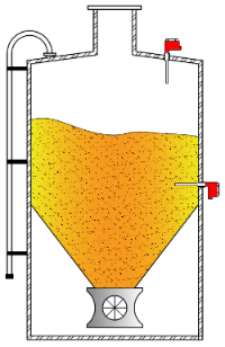
Typical applications for point level switches:
- High or low level alarm
- Overflow protection
- Leak detection
- Oil/Water Interface
- Pump control
Liquid & Dry Materials:
- Water/Wastewater
- Acids/Caustics
- Chemicals/Oils
- Slurries
- Flour/Grains
- Powder/Plastics
- Sand/Cement
Click here to view LS7000 Level Switch Video Demo
Point Level Switch FAQ
What types of media can Babbitt point level switches reliably detect, and how do I choose the right model? +
Babbitt RF admittance point level switches detect liquids, conductive or non-conductive media, slurries, powders, and bulk solids by measuring changes in capacitance and dielectric constant. Model selection depends on dielectric properties, coating tendency, process temperature and pressure ratings, insertion length, and required output (relay or 4-20 mA loop-powered).
How does RF admittance technology compare with vibrating or paddle type switches for false triggering and buildup resistance? +
RF admittance technology measures true impedance changes at the probe and uses active shield circuitry to ignore conductive buildup. Unlike vibrating forks or paddle switches, which rely on mechanical movement, RF admittance compensates for coating and prevents false trips caused by material adhesion or bridging.
What environmental conditions and hazardous location certifications can Babbitt point level switches operate in? +
Operating limits vary by LS series model but are designed for industrial process environments with elevated temperature and pressure ratings. Hazardous location configurations are available with certifications such as Class I, Division 1 or Division 2 approvals for use in explosive atmospheres.
Can Babbitt point level switches ignore foam, sludge, or surface turbulence when detecting liquid levels? +
Yes. RF admittance sensing differentiates between minor dielectric changes, such as foam or turbulence, and full material contact. The active shield design cancels stray capacitance and buildup effects, reducing nuisance alarms.
What are the typical response and reset characteristics of Babbitt point level switches? +
Electronic response is near-instant once the probe senses a dielectric change, and reset occurs immediately when material clears the probe. Switching outputs typically include SPDT relay contacts or solid-state outputs configurable for fail-safe high or fail-safe low operation.
Do these switches require calibration before installation, and how often should they be recalibrated? +
Most RF admittance models are factory calibrated and require minimal field adjustment. Sensitivity tuning may be performed during commissioning to account for dielectric constant variations. Recalibration is typically only required if process conditions significantly change.
What spare parts and repair support does Babbitt offer for the LS2000, LS6000, or LS7000 series? +
Field-replaceable electronics modules, probes, and gaskets are available depending on the LS2000, LS6000, or LS7000 series configuration. Factory repair, troubleshooting assistance, and replacement parts support long-term maintainability.
Can a single model be used for both high-level alarm and low-level control? +
Yes. Most models can be configured for high-level alarm, low-level alarm, pump control, or interlock functions using relay wiring configuration and fail-safe selection. Installation height determines the switching point.
What are the process connection and installation requirements for Babbitt point level switches? +
Process connections may include NPT threaded fittings, ANSI flanges, or custom connections. Probe length must match vessel geometry, and horizontal or vertical mounting affects buildup exposure and sensing reliability.
What documentation or certificates of compliance are provided with an order? +
Orders may include installation manuals, wiring diagrams, hazardous location certificates, material traceability documents, and certificates of compliance based on configuration and industry requirements.