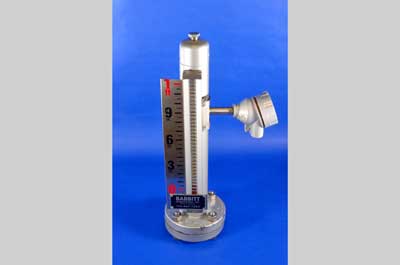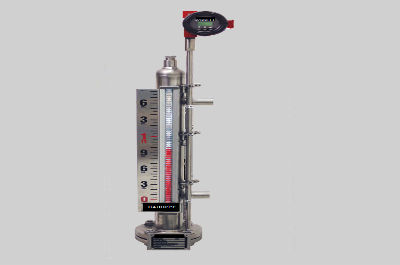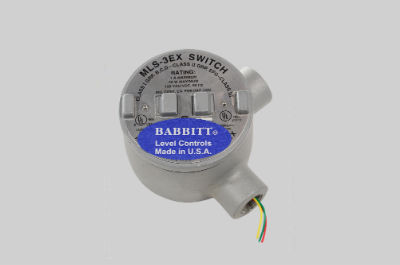
Babbitt Magnetic Level Indicators are a safe, non-invasive way to measure fluid level inside a tank, without the risks of a sight glass. Because the fluid never contacts the indicating glass, they are especially safe for flammable, toxic and corrosive liquids, with no possibility of leakage even if the glass breaks. Each system is custom made to meet your application, with transmitters and alarm switches available below.
Magnetic Level Indicators (LG Series)
The core LG Series indicator uses a magnetic float and flipper scale to provide a continuous visual level reading, with no fluid contact against the viewing glass. View LG Series specs and mounting options →
LT-1/LTM Level Transmitters
Add a side-mounted transmitter to send a 4-20mA signal to a remote location for indication or control. Compare LT-1 and LTM transmitter options →
Magnetic Level Alarm Switches (MLS Series)
MLS Series switches mount externally to the float chamber and can be repositioned without shutting down the process. See MLS alarm switch models →
Frequently Asked Questions
What is a Magnetic Level Indicator? +
A Magnetic Level Indicator, also called a level gauge, is a safe, simple and reliable way to measure fluid level inside a tank. It's a non-invasive alternative to a sight glass, and since the fluid never contacts the indicating glass, there's no possibility of leakage even if the glass breaks.
How does a Magnetic Level Indicator work? +
The indicator consists of a chamber, a magnetic float, and a flipper-type indicator scale mounted to the side. Fluid in the tank seeks its own level inside the chamber, and the magnetic float rises and falls with it. As the float moves, it changes the orientation of the flippers on the scale to provide a visual level reading, and it also actuates any transmitter or alarm switch attached to the gauge.
Are Magnetic Level Indicators safe for hazardous or corrosive liquids? +
Yes. They're especially well suited to flammable, toxic, and corrosive liquids because the fluid never comes into contact with the indicating glass. Should the glass ever break, there is no possibility of leakage, which is a key safety advantage over a traditional sight glass.
What materials are Magnetic Level Indicators made from? +
Each indicator is custom made based on the process fluid, pressure, temperature, and specific gravity involved. They're generally constructed of 316 stainless steel, but can also be built from CPVC, Kynar, Hastelloy, Monel, or other exotic metals. Units are ASME code welded and available in lengths from 12 inches to 40 feet.
Can transmitters or alarm switches be added to a Magnetic Level Indicator? +
Yes. A side-mounted transmitter can be added to send a 4/20mA signal to a remote display, PLC, or DCS, and MLS Series alarm switches can be clamped externally to the chamber for alarm or control functions. Both can be added, adjusted, or serviced without cutting additional holes in the vessel or shutting down the process.
What's the difference between the LT-1 and LTM transmitters? +
The LT-1 is a lower-cost, analog transmitter with no digital display, providing step-up level readings in 1/2 inch increments (1/4 inch resolution on units under 30 inches). It's a good fit where precise measurement and communication protocols aren't required, and is often preferred for applications with significant vibration.
The LTM 250/350 series uses magnetostrictive technology for highly accurate, precise measurement. It mounts externally and senses the magnets inside the float, and is available with two-wire loop-powered 4-20mA output or bus-powered Fieldbus digital output, with remote-mount electronics available for high-temperature applications.
What alarm switch options are available? +
The MLS-3 Series is a hermetically sealed reed switch with Form C contacts, best suited for low-power alarm signals. A bias magnet latches the switch as the float passes and only unlatches when the float returns in the opposite direction.
The MLS-10EX is a high-current switch designed for controlling pumps, alarms, or solenoids, using a cam-activated, UL-approved internal switch. All MLS switches can be wired for rising or falling level and NC or NO operation, with roughly a 1/2 inch deadband to prevent chatter.
Can Magnetic Level Indicators measure interface level, not just total level? +
Yes. In addition to total level, Magnetic Level Indicators are used for interface applications such as oil/water, crude/brine, foam/liquid, liquid/gas, and liquid/vapor interfaces, including offshore installations.